

Interview: Yoga’s Healing Power
Human behavior is as complex as it gets. And by “behavior” I mean not only how people act or react, but also how they perceive, think, and feel. Having learned to appreciate this complexity during my many years of study has made me respectful and humble about working with human beings.
If you know Jessica Wiese (née Komes) or talk to her, you will soon understand that her work and life as a yoga teacher has many facets. Her Ph.D. in Psychology and Cognitive Neuroscience helped form the foundation of her career as a yoga teacher and stress management trainer. The depth of Jessi’s expertise shines through whenever you attend her classes. Born and raised in Germany, she now teaches a broad audience in Durham and Newcastle upon Tyne, UK, offering community classes and supporting people affected by severe health conditions, including cancer.
How did you become a yoga and meditation teacher in North East England?
I moved here from Germany with my husband in late summer 2014 for his job at Durham University. We felt excited about starting a new life. I’ve always loved spending time abroad, and for some of my undergraduate and graduate studies, I went to Mexico and the US.

Even before we arrived here, yoga had already become a tremendous resource for me: not only through my own practice and the joy and solace it brought me but also through my teaching. I was teaching in three different yoga studios in Germany, and it had become an important part of my life. Meanwhile, I was struggling with my Ph.D. and my academic self, which of course had spill-over effects on my relationship with my partner, especially since he and I worked together at the time.
When we came to Durham, I was still working as an academic, but quite independently. It was a part-time position, funded through a research foundation. This allowed me to peacefully explore my life here and set up yoga classes, which was my heartfelt wish.
I think I was at a point in my life where I felt trapped by academia, and yoga was a way of unfolding. Luckily, the North East of England needed yoga, too, and I believe I came here at the right time, as there were several opportunities to teach that opened up right away. So I could start teaching, both in Newcastle and in Durham, almost as soon as we arrived.
Does your academic training in psychology come in useful in your work as a yoga teacher?
Actually, sometimes I feel my students bring that expectation. They approach me with a higher level of trust because I am a psychologist and have these two little letters (Dr.) in front of my name. It is then up to me, of course, to try to live up to their expectations.
Studying psychology taught me that human beings are complicated — without the negative connotation, this word may entail. Each psychological discipline (e.g., differential, developmental, social, or biological, to name just a few) emphasizes different ideas about how and why people behave as they do. And by “behavior” I mean not only how people act or react, but also how they perceive, think, and feel.
Having learned to appreciate this complexity during my many years of study has made me respectful and humble about working with human beings. I hope that this attitude spreads to the yoga classroom. For private sessions, which often deal with more therapeutic matters, my training in psychology helps me to have a conversation about what a client brings to the practice, what they may be facing. Knowledge about human complexity also helps me to be aware of my limitations in helping others.
Does your past experience as a researcher affect your yoga teaching, too?
Since I am a cognitive neuropsychologist by training, I know a good deal about the research in this field concerning yoga and its effect on certain diseases, and how yoga affects the nervous system. This makes it easy for me to mention these findings in classes or private sessions. For example, if I want to encourage a client to try a particular technique that they might be skeptical of — such as a mantra or light visualization — I can make a simple but profound comment about how research shows this method triggers a mechanism in the brain which is beneficial for the regeneration or healing process. This can be very persuasive.
My academic background and yogic training have made me aware of how much work there is to do in helping people connect to their own selves.
What relationship do you see between science and yoga?
I sometimes ask myself:
- Why do research findings so easily outweigh a person’s belief or their own experience?
- Why do people have so little trust in themselves or in their own intuition? And,
- Do I really want to use scientific research to “sell” yoga, mindfulness, and meditation?
By doing so, I feel that I am not adequately acknowledging the power of yoga itself, with its long history and abundant wisdom. It’s like saying we can value yoga only if it causes a significant test result. As an (ex-) academic, I tend to be a critical reader of the studies I use to support my work. I know that a single research finding from one study might not be reliable. Furthermore, scientific studies can be very well or very poorly designed.
On the other hand, of course, it is great that research has been conducted allowing yoga and related practices to be accredited and integrated into the healthcare system. Yoga is certainly the most scientifically examined complimentary therapy. You can find hundreds of randomised well-designed studies on the effects of yoga on various diseases.
For a quick summary here:
- There is credible, research-based evidence that even one twelve-week course of yoga will continue to alleviate back pain a full year after a client has completed the course.
- There is also convincing evidence of yoga’s beneficial effects on clients going through treatment for breast cancer, Type-2 diabetes, asthma, and depression.
- There are also several studies showing that yoga has a positive effect on blood pressure.
- As a treatment for depression specifically, a regular yoga practice can apparently obtain a similar remission rate as that achieved by psychotropic drugs or group therapies.
To my understanding, there are only a couple of cases in which yoga has had an adverse effect on clients with psychotic mania or bipolarism. However, this seems not to carry over to other psychotic illnesses such as schizophrenia.
Beautiful research results, however, cannot release us from our responsibility of looking after ourselves and our students. As yoga practitioners and teachers, we still need to listen to our inner voice. Luckily, this is something we learn — and keep learning — through yoga.
Are there any misconceptions of yoga or mindfulness in the mainstream that bother you?
It is inappropriate that yoga and mindfulness, or even yoga and meditation, are sometimes presented as separate from or independent of each other. As you pointed out, the reason might be that yoga (who knows why?) has until lately been seen mainly as a workout or kind of sport. If we subtract mindfulness or awareness from Hatha yoga, then I guess we do get stuck with or over-focus on the physical aspects.
Mindfulness, like awareness, is the undergirding for yoga. And not only for yoga but for all routes that enable us to travel inwards — including psychotherapy. That does not mean that I see mindfulness as a precondition for practicing yoga. As a yoga student and teacher, I know that we can learn to be more aware and more mindful over time and with practice.
I have met a few people who would argue that they come to yoga for the physical aspect only. They are the ones who like to leave before savasana and meditation, but at the same time, they do not have an answer as to why they prefer yoga over other classes or courses. My theory is that they at least get a sense that yoga benefits them in ways beyond what they are aware of, and that that is what keeps bringing them back to the mat.
Yoga is so rich, the longer I practice and teach, the more I realize this. We as teachers and as students need to remember and honor the manifoldness of yoga, and if we do, this will hopefully contribute to how yoga is perceived and presented.
How do yoga and mindfulness help with wellness in people affected by an illness?
On a very general level, a disease or a condition that imposes on your health and well-being is a constant and severe stressor. With yoga, we can reduce stress. For instance, it can be a huge relief to learn through yoga that we can actually observe the mind and that we are not our minds — we are not our worries and doubts.
Yoga philosophy can also offer a whole new perspective. As human beings, we often take what is happening to us very personally. We thereby feed negative patterns of our mind, which won’t help recovery. Yoga, meanwhile, helps us to learn not to define ourselves by or identify so much with an illness or other condition.
Yoga can help us make peace, even, with that disease or condition that is a part of us. We may learn to address it as such rather than fight it, and thereby a whole new mindset and set of resources is opened. I have observed this shift in perspective in a range of clients affected by a disease or other condition. It is very empowering. Not only is the shift beautiful in itself, as there is less of a battlefield. But it also allows for energy to be directed where it is really needed — to healing or to not getting worse.
Yoga supports emotional regulation because the practice teaches us to invite different qualities of energy in. Acknowledging negative emotions — addressing them through awareness, embracing them instead of suppressing them — helps us to cope with or eventually release those emotions rather than getting stuck in them, or numbing out.
On a mere biological level, yoga can re-establish a hormonal equilibrium that may have been thrown off-balance by the conditions you mentioned. This certainly helps the healing process and works to prevent additional threats to a person’s health.
Which illnesses have you encountered during your career as a yoga teacher?
I wish I could tell you about all the wonderful encounters I have had with people letting me in and trusting me to work with them. Bringing this to mind really touches my heart. It is amazing to observe the changes people go through. How their bodies open up after a while, even if they’re only going to class once a week.
On the more subtle level, I can see how they unfold, and something sparkly shines through — a part of themselves that they have not been in touch with before.
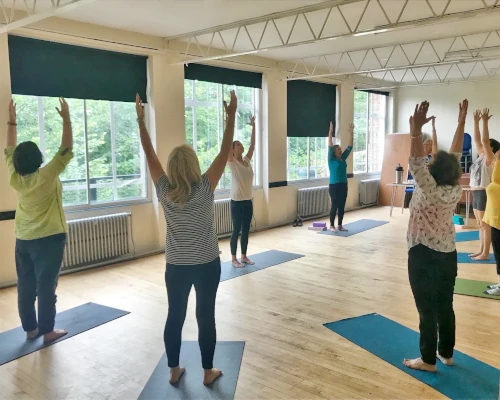
I have been teaching a group of visually-impaired/blind people and also individuals who have experienced trauma from violent attacks, abuse, war, or from losing a significant person to death. Moreover, patients with neurological conditions, like Parkinson’s or Restless leg syndrome, as well as people suffering from chronic fatigue and mild to moderate depression or over-generalized anxiety make their way into my classes or private sessions. All of their stories are unique and worth mentioning.
Working with my friend, Cristiana, who was also a psychologist and cognitive neuroscientist has influenced me a lot. She started coming to my classes while she was undergoing treatment for an aggressive brain tumor. I could talk to her about how the diagnosis had changed her perception of herself and of the world — including her understanding of yoga, its philosophy, and psychology.
Before I worked with Cristiana, I sometimes feared that a person with a fatal illness would be annoyed by the quotes or poems I brought to class, or when I tried to deliver some yogic philosophy about life (and sometimes even about death). I feared they would think, “Well, easy for you to say to stay in the present moment and enjoy your breathing. I have a year to live. Don’t give me your ideas about a place in me where I can find peace and calm; that’s not going to happen.”

But Cristiana encouraged me to keep bringing yogic philosophy and psychology into her practice. She said she needed exactly that to cope with daemons in her head. She also encouraged me to set up a yoga and meditation class specifically for people affected by cancer. It is the first and so far the only one in Durham.
During a mindfulness workshop that I recently led for FACT (Fighting All Cancers Together: a Gateshead-based charity organization), I asked the attendants how they felt about befriending their cancer as a way of reconciliation and a perspective on healing or at least dealing with the illness. A lady commented that she wouldn’t wish her worst enemy to have it, and at the same time, she wished everyone could. She said having cancer had taught her so much. It had made her more mindful and alive. I was so inspired by her.
What are your thoughts on the relation between yoga, body image and eating disorders?
Well, this is a current debate. Firstly, I hope it goes without saying, but yoga itself is not a risk factor. It does not entail any body image and hence cannot contribute to one, or to prompt an eating disorder.
That said, yoga is often advertised in a way that appeals to the fashion world. This is a way of conceptualizing yoga primarily on a physical level, which may lead to associations of thinness and flexibility. But this is, without doubt, an inadequate and insufficient portrayal. And the issue is not unique to yoga; adverts I see for Pilates or fitness classes look about the same.
It might be interesting to see if we could bring more overweight people into classes by promoting yoga differently — with different images. Most of my students are thin to average weight. This is true across the board; in my private sessions, studio classes, and meditation/mindfulness workshops. Rarely do I meet a yoga student who is overweight, and this includes most teachers I know.
Secondly, yes, I understand that we are all under pressure regarding our bodies. Our current norms make us believe that looking good equals being slim and that this (sometimes paradoxically) also equals being healthy. The more yoga becomes a mainstream practice in our culture, the more people may make these connections.
But let’s pause here for a moment. Instead of blaming yoga for certain phenomena, I would much prefer to acknowledge it as an ancient practice offering a great potential for healing the so-called modern illnesses in our world.
I am convinced that anyone who practices yoga regularly, even students who understand yoga as a workout and nothing more, will not escape its deeper effects and revelations. We need to trust that anyone who is seriously interested will discover their teacher and way of practicing, independent of whether their motivation is personal development, health, and well-being, spiritual solace, or if they come to class to “just” keep fit. This will be particularly the case for students whose teacher has tapped into the abundance of yoga and tries to convey a holistic approach in class.
How can yoga help people suffering from eating disorders?
Yoga teaches us to (re-)connect and listen to ourselves. This helps to cope with difficult experiences and negative feelings. It teaches us to be what we are, to take care of ourselves through awareness, mindfulness, and acceptance. With an eating disorder, you cannot listen like this anymore.
I resonate a lot with the explanation provided in Carolyn Costin and Joe Kelly’s beautiful book, Yoga and Eating Disorders: Ancient Healing for Modern Illness. With an eating disorder, Costin and Kelly explain, a profound disconnection has arisen in a once-healthy soul, causing the mind and body to run amok. The mind itself can get hijacked.

Healthy people can fall into this pattern too. How often, for example, do we feel driven by our egos to achieve more or look a different way, or to perform better at something? But for people with eating disorders, there is no escape.
It must be understood that people do not choose eating disorders. It is not their fault that they have this disorder. Too often, I encounter too little or a lack of compassion for clients with eating disorders — even from doctors or other health professionals. These people do not starve themselves, or binge and purge, out of a simple desire to be trim. Nor is it true that people who suffer from overweight or obesity simply lack discipline.
Eating disorders are often accompanied by a lot of shame and guilt. How can clients recover when they keep facing so many judgemental reactions?
People who develop an eating disorder have often been made vulnerable by a number of pre-existing risk factors (e.g. age, unstable family relationships, an environment that over-focuses on achievements and/or on body weight), and/or a lack of protective factors (e.g. resilient social/family structures and support, emotional outlets).
An eating disorder is born in reaction to deep pain and emotional distress — an injured self takes over and overrides the healthy self in an attempt to protect it.
Yoga alongside psychotherapy can help to dig this healthy soul free again! For example, through the deep listening our practice entails, cultivating acceptance and kindness for ourselves, healing emotional wounds and realizing that the ego may be tripping us with thriving towards achievements and perfection!
Some schools of psychotherapy hold that an eating disorder is more or less functional. I resonate with seeing the development of such as the best option to deal with a situation at that moment. Hence, an eating disorder arises as a coping strategy. Even if the exact cause of an eating disorder is not identified, the client has felt that the world is not a safe place and the “eating or not eating” has provided a sense of control over the world when the person was harmed or most vulnerable. The person thus feels this behavior needs to be maintained to survive and to cope with life further. Taking away someone’s coping strategy when not having provided them with something to replace it with, can cause even more damage.
Providing this perspective can also help making family members and health professionals aware of how scared clients are to let go and recover. Yoga, accompanying psychotherapy, can help find a different, less-harming coping strategy through the practice of deep listing and befriending, embracing the self with its many facets.
Also, on a cognitive-neural level, yoga also can have an effect on the brain and its circuits, which are formed by patterns of behavior and which support and enable behavior in turn. Yoga may help to rewire neural structures, which helps to establish and consolidate new (and healthier) behavior.
So, no matter how we define or approach the phenomenon of eating disorders (or other mental health imbalances), yoga can help from various perspectives.
What else is missing in the public discussion about yoga, mental health, and general well-being?
Since I came to the UK three years ago, it has struck me how little yoga has been established as a tool for preventive care here. In Germany, health insurance covers three months of weekly yoga sessions per year, which shows how seriously the German healthcare system takes yoga. It has also been quite well established in clinical settings, compared to what I observe here in the UK.
In Durham, I work with the Alington House Community Association. They have a community center, where I offer sessions that are funded through various foundations and trusts. In these sessions, I reach people who could not afford yoga otherwise. Some of them have been severely physically or mentally harmed.
I hope to encourage a discussion on how to make yoga more accessible to everybody. Not with the aim, though, to “fix” people, but to create a healthier and more (self-) compassionate society. I believe this would help to prevent many (mental) health issues and significantly contribute to making the world a better place.